Fake Door MVP
Last Updated: January 2025
Fake Door MVP lets you test interest in a product or feature before there is anything at all. Joel Gascoigne, the founder of Buffer, wanted to test if anyone would be interested in a tool that lets you post to Twitter more consistently. (This was 2010, Twitter was the place to be.) His initial test was a simple landing page describing the idea, followed by an email sign-up. Once initial interest was validated, he introduced a pricing page before the sign-up, which then led to a message saying, ‘Sorry, we’re not ready yet.’ This allowed him to test both interest and willingness to pay.
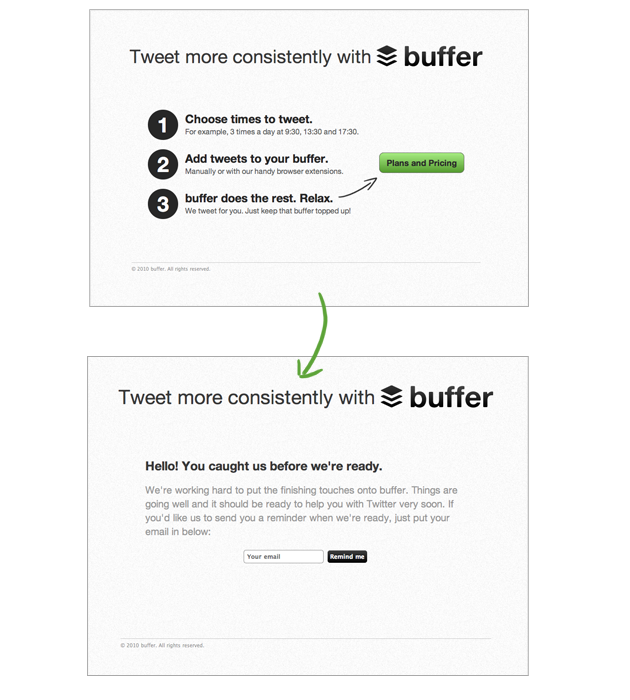
Fake Door Key Elements
- Process: Create a simple landing page with your offer. Have a clear and compelling Call to Action (CTA). In some cases, organizations use a fake brand to test interest, without revealing their real name.
- When to use it: Validate Demand with minimal effort. Along with a landing page, it can even be used in an existing product to see if anyone is interested in a new feature.
- Measurement: Do people click on the button? Do they answer the CTA? i.e. Do they sign up to be told when the product is available?
As AI slop takes over the internet, I would seriously use simple hand-drawn images to make it clear that there are real people and not just an AI.
Pros and Cons of Fake Door
Pros: They’re easy to make and low-cost. You can build them in-house, and before you have any product. Time and money are saved by not building something that no one wants.
Cons: How will people find your landing page? Likely paid ads. Also, overuse or unethical implementation can damage brand credibility, so transparency and restraint are key.
Fake Door is one type of Minimum Viable Product.
Image attribution: Buffer Fake Door image from: https://buffer.com/resources/idea-to-paying-customers-in-7-weeks-how-we-did-it/