Surviving the AI Tsunami
An evidence-based course that turns GenAI from a code firehose into validated value, for the Scrum Masters and Product Owners who have to make it work.
Reserve your seat
$1,099 CAD. Capped at 10 seats so I can coach everyone properly.
- 6 weeks, starting September 28
- Twice a week online, Mondays and Fridays, 1pm EDT / 7pm CEST / 10am PDT
- The week of Canadian Thanksgiving, the Monday session moves to Tuesday, October 13
- Times stay anchored to 1pm Eastern; daylight saving shifts the other zones late in the course. The week of October 26 is 1pm EDT / 6pm CET / 10am PDT (Europe changed October 25), and from November 2 it is 1pm EST / 7pm CET / 10am PST (North America changed November 1)
- Each week: one learning session (60-90 min, recorded) and one live lab to put it to work (60 min)
- Between sessions, bring real problems from your team to the forum and get unstuck
What you’ll walk away with
Six weeks in, you’ll be able to:
- Measure AI’s real impact on your team You’ll set up Cycle Time, Throughput, and Mean Time Between Rollbacks, so you can show whether GenAI is actually helping or just creating motion, and forecast delivery with Monte Carlo instead of velocity guesswork.
- Evolve the ScrumMaster and Product Owner roles You’ll make specific changes to how your team works so it gets more out of the GenAI shift, instead of a hollowed-out version of itself.
- Spot the expensive traps before they cost you Franken-products, pull requests no one can review, cognitive debt. You’ll learn the common GenAI adoption failures and what to do instead.
- Protect quality and lower risk while you move faster You’ll slice work small, validate features with real users, and keep every change reviewable, so speed doesn’t show up later as rollbacks, bugs, and burnout.
And you’ll learn to do all of this in a way you can still afford when the price of GenAI climbs, which it will.
Velocity is up. Value isn’t.
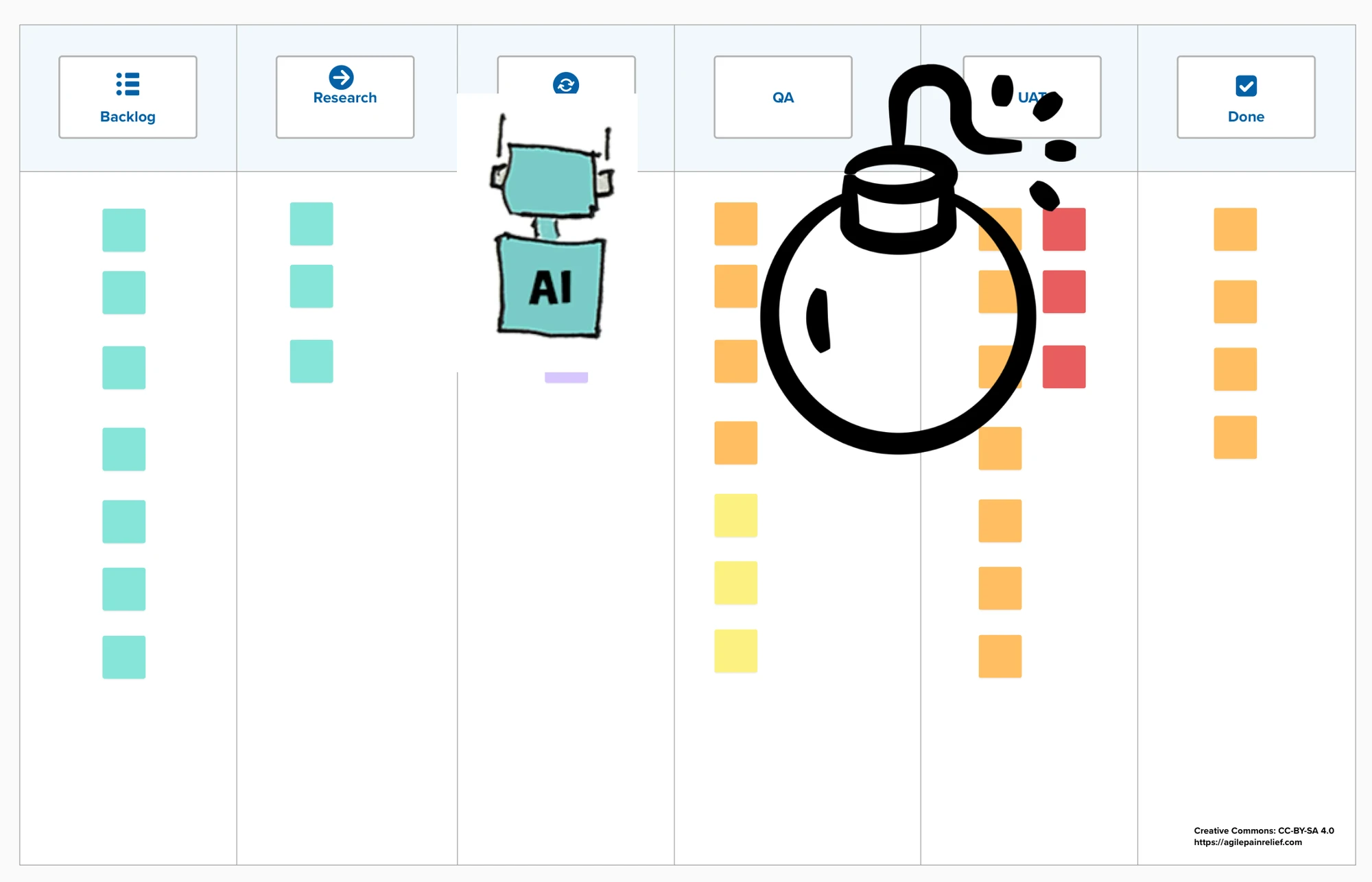
It starts with pressure. You’re told to use AI. Maybe it’s in your performance review. Now point that pressure at the backlog most teams already have: 150+ items, half of them old, most never validated with a real user. AI starts blasting those features out, big ones, fast. The pull requests balloon. Reviewers fall behind on code they no longer fully understand. Testing can’t keep up. What slips through lands in production as rollbacks, hotfixes, and security holes that sit open for months. At the end of the pipe are your users, getting features nobody asked for and an experience that keeps cracking.
There’s a lot of noise. So much of it that the real value of the technology gets buried. Underneath the noise, the economics are shifting. OpenAI and Anthropic are venture-backed startups that hooked us with low prices, and those prices have to climb for the businesses to work. The models keep getting better by burning more tokens, so the bill for the same work keeps rising, and it rises fastest on a large codebase.
AI will replace software engineers in two years. They’ve been saying that for more than two years now.
The real question isn’t whether AI replaces your team. It’s whether you can afford the way your team is using it today, and whether what it ships is worth the cost. That’s what this course is about: using GenAI so the value still holds up when the price climbs.
It’s amazing that an AI can generate a codebase from scratch in hours. But that vibe-coded product won’t be coherent, usable, or maintainable, and it keeps shipping with security flaws. I know because I’ve done it. I’m building a family expense-reconciliation app with Claude Code, and I’m more careful than most people. I still shipped it with receipt images publicly exposed, which sent my egress bill through the roof before I caught it. And I only found out the hard way what happens when the AI service the app leans on stops responding while someone’s mid-upload. I try to be careful and I still make mistakes.
To make GenAI work for us, and not us working for the AI, we need an evidence-based approach.
GenAI isn’t the villain. The villain is the speed-over-quality culture that’s using AI as cover.
If it feels like your team is being pushed into using AI faster than you can sustain, you’re not alone. I’ve been watching teams navigate this for two years, and it’s the same conversation everywhere. The numbers are up, but the backlog isn’t shrinking, throughput isn’t really improving once you count the bugs and rework, and we’re not creating more value.
Build the right things, not just more of them
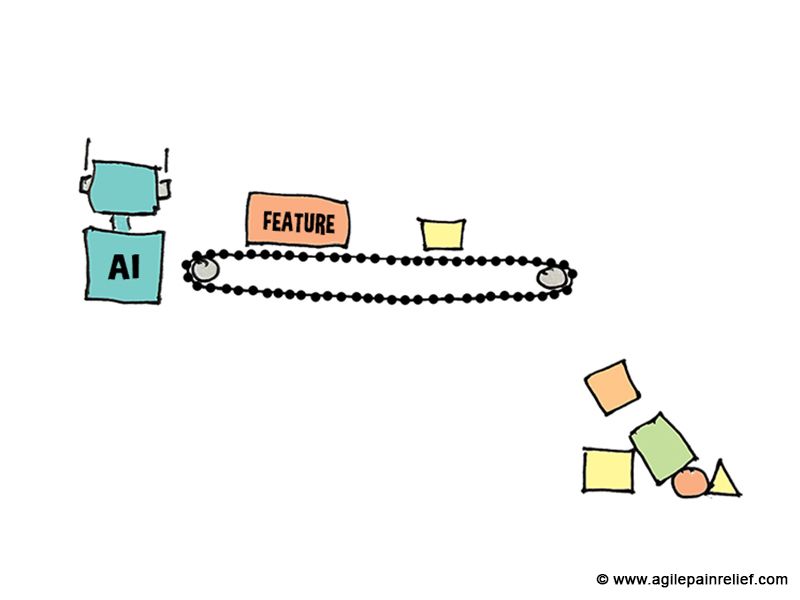
You don’t need more promises of magic. You need answers to the questions your team is wrestling with right now. Here’s some of what we’ll work through:
- “Our Product Backlog is over 150 items, can we use AI to get through it faster?” You could, and you’d get a Franken-product: a pile of parts that barely fit and nobody wants. We’ll do the opposite. You’ll learn to validate the next few features with real users before building them, so AI speeds up the work that’s actually worth doing instead of all of it.
- “It built a huge PR, we can’t review or test it reliably.” When AI generates a large feature in one go, the existing bottleneck just gets worse. Writing code was never the bottleneck. So writing code faster just makes the downstream problem worse. We’ll fix the refinement step that’s missing before the code: slicing the work small so every change stays reviewable and safe to ship.
- “We have a massive story, can we use AI to make it smaller?” We don’t need AI. We need practice splitting it. We’ll practice slicing work so it flows, with clear acceptance criteria (Specification by Example, BDD) that both your team and the AI can build against. When the team has done their first pass, the AI does a good job of pointing out missing edge cases.
- “Can AI foresee something we haven’t?” Not really. AI doesn’t think or imagine, but it can chew on a problem dozens of times without getting bored, so it’s good at flagging asking the same question over and over. You’ll practice putting that to work, using techniques like the PreMortem to stress-test a plan or design before you commit, while your team still owns the discovery and refinement AI can’t do.
- “Can AI improve our forecasting and help identify our bottlenecks?” Velocity is a poor measure for both. We’ll set up the ones that work: Cycle Time, Throughput, and Mean Time Between Rollbacks. These give you hard numbers to take to leadership on whether GenAI is actually paying off, or quietly isn’t, instead of more hype. You’ll use the same measures to make realistic forecasts and pinpoint the real bottlenecks, with GenAI as a sparring partner once you’ve found them.
- Telling hype from substance. You’ll get a fitness-for-purpose lens for where GenAI actually earns its place in your workflow and where it just adds noise.
- Protecting your team and your role. We’ll deepen the ScrumMaster and Product Owner roles and guard against cognitive debt, deskilling, and burnout, so a year of GenAI doesn’t leave the team unable to reason about its own code.
What people say about learning with Mark
Lived experience, immediate value, no filler.
How it Works
Normally, I promise no PowerPoint; however, this is a new course, so some sessions will use slides. That lets me adapt the content as I learn what’s actually getting in your way.
- Reserve your seat on Corsizio $1,099 CAD. Capped at 10 seats so I can coach everyone properly.
- Warm up with a 15-minute foundations primer A short pre-read and the “right tool, right reason” checklist, so we all start on the same page. The forum opens the same day.
- Meet twice a week for 6 weeks Starting September 28, Mondays and Fridays, 1pm EDT / 7pm CEST / 10am PDT. Each week: a learning session (60-90 min, recorded) and a live lab to put it to work. The week of Canadian Thanksgiving, the Monday session moves to Tuesday, October 13. Times stay anchored to 1pm Eastern; daylight saving shifts the European and Pacific equivalents in the final two weeks (from November 2: 1pm EST / 7pm CET / 10am PST).
- Experiment with your own team Pick one improvement each stage, try it for real, and share what happened in the forum: what worked, what didn’t, where you got stuck.
Email me at mark@agilepainrelief.com with questions, or click register on your right.
Is this you?
This is for you if:
- You’re a ScrumMaster, Product Owner, Tech Lead, Developer, manager, or coach in software delivery, and you’re being pushed to “use AI” faster than feels safe.
- You want to tell hype from what actually works, instead of taking a vendor’s word for it.
- You’re willing to try things, make mistakes and share what you learn.
- You’re comfortable with the basics of Scrum or Kanban. Your team doesn’t need to be doing either, understanding the language of Agile helps.
This is not for you if:
- You want a certification or a badge. There isn’t one.
- You’re looking for a tour of the latest AI tools and prompts. This course is about the judgment underneath them, the part that outlasts any tool.
- You’re convinced AI will replace your engineers next year, and going faster is the only goal.
Full course outline
By the time we’re done, you’ll be the person in the room asking the questions that keep your team out of trouble when the next AI claim lands. You’ll know how to make GenAI build the right things instead of just more of them, and you’ll have seen for yourself that the advantage was never speed. It’s quality and product-market fit.
Here’s the path we take to get there:
Foundations
Self-paced pre-work, plus forum access, before the cohort begins. You’ll cover:
- Basics of GenAI: How it works and what its limitations are.
- The fitness-for-purpose checklist: A checklist to make sure that GenAI is being used in the right place and for the right reasons.
- How GenAI Fails: There are a number of failure modes for GenAI, beyond hallucinations. We need to understand how they fail, to know what to guard against.
Measurement and Flow
- Improving Measurement: We will set up a measurement process that includes Cycle Time, Throughput and Mean Time between Rollbacks. We will use these measurements throughout our work to understand the impact of AI on our team and the system.
- Improving Forecasting: We will learn to use Cycle Time and Monte Carlo Simulation to improve forecasting. Oddly enough, this is one area where AI isn’t all that helpful.
- Writing code faster was never the constraint: Why more code, faster, isn’t delivering more value, and what to do about it.
- Finding the Real Bottlenecks: Code was never the constraint to delivering value. We will learn how to identify bottlenecks and how GenAI can help.
Role Evolution
- Scrum Events: What AI Can (and Can’t) Help With: The Scrum Events (Sprint Planning, Daily Scrum, Sprint Review and Retrospective) are designed to help build a shared understanding of the work and improve collaboration. Our use of GenAI should be to help improve these benefits and not eliminate them. Too much focus is placed on using the AI to speed up the events, instead of focusing on using the AI to ask better questions. For example, use the PreMortem technique to ask questions about a team’s Sprint Plan, to test before we start the Sprint.
- Deepening the ScrumMaster Role: Introducing Systems Thinking puts the emphasis on coaching the team and the system. We will use GenAI as a sparring partner for Systems Thinking exercises, not as a replacement for human thinking.
- Evolution of Product Ownership: Product Owners need to focus more on experimentation and validating user needs. Innovation still requires human creativity. Don’t use the GenAI to replace your innovation; instead, use it to critique your ideas and build tests that validate your hypotheses.
Technical Realities
- Vibe Coding promises a miracle: Building applications without needing engineers, or so we’re promised. GenAI can be very useful; it’s not magic.
- Agentic AI: Everyone calls their tools “agentic”. What’s hype, what’s practical? Hint: Boasting about TokenMaxing and the number of agents you can run at the same time isn’t focused on delivering value.
- Vibe Coding, used safely: Where vibe coding genuinely earns its place (prototypes and experiments to validate an idea fast) and how teams ship the real thing: validate features with experiments, then use BDD or Specification by Example to set clear acceptance criteria, collaboratively, before the production code gets written.
Human Wages of AI
- Cognitive Debt: If technical debt is the cost of hard-to-maintain code, cognitive debt is code that we don’t understand, usually because it was written by GenAI.
- Deskilling and Knowledge Cliffs: What happens to a team’s ability to debug, design, and reason about code once GenAI has been doing the work for a year?
- Burnout and other human costs: Spending hours a day interacting with GenAI is leading to burnout.
Why listen to me
I’ve taught Scrum and Kanban to over 8,000 practitioners over 16 years. This course is the next evolution of that work, built for a world with GenAI in it.
I’m not coming at this as a cheerleader or a doomsayer. I’m an explorer. I don’t sell tokens, and I don’t need to justify hundreds of billions in GPU spend.
I’ve survived every tech hype cycle since before Gartner started tracking them: 4GLs, the Apple Newton, CORBA, Java Applets, the Segway, No Code, the Metaverse, and on. In several of those I had to keep the technology running while we waited for the promised moon. (Hello CORBA, Newton, and Java Applets.) GenAI is the loudest hype cycle I’ve ever seen. Trillions in investment, yes. Trillions in value? No evidence of that, so far.
FAQ
Why isn’t this a certification course?
Because the certification courses that exist today are focused on better prompt engineering. Better prompts will get you better output from a chatbot. They won’t tell you whether the system around you is getting better or worse.
Do I need to be technical?
No. You won’t write code here. You’ll learn to lead a team that uses AI well. If you can read a pull request title and follow a conversation about flow, you’re set.
Will you teach me the best AI tools and prompts?
No. The tools change every month. This course is about judgment, flow, and value, the things that still matter when the tool changes.
Is there homework?
Light but real: one experiment with your team each stage. That’s where the learning actually happens, and the forum is there when you get stuck.
Refunds
If, at the end of the first session, you realize this isn’t for you, we will offer a full refund.
Access
You will have lifetime access to the course materials and any updates.
What’s at stake
AI is already coming for the shallow work. ScrumMasters seen as JIRA jockeys are ripe for replacement, and Product Owners who just relay feature requests will be replaced, badly, by AIs. The ones who learn to use GenAI well become the people their teams can’t do without. That’s who this course is built to make you.
Ready to join the cohort?
Not sure this is for you yet?
Get evidence-based, hype-free takes on making GenAI work for your team. No selling you tokens, no doomsaying.