Difficult Team Member? Change the Situation, Not the Person
Last Updated: September 2026
Do we really have a difficult person? Or do we have a good person stuck in a difficult situation? Nine times out of ten, the circumstances are the problem.
Great Retro. … All was well until we reconvened for sprint planning when the most senior and definitely more vocal team member announced that we should not spend any time on the process improvements until we were finished our other sprint tasks.
The PO or team member does all the talking, they make all the decisions without consulting others … they’re too powerful to be dealt with by junior members, sometimes even by a scrum master.
how do you deal with resistance of the type: “we tried that before and it didn’t work” or “it doesn’t matter if we don’t get everything done this sprint.” … The problem I see is because they’re a veteran on the team and we have a lot of new people on the team, they immediately take what that team member says as gospel.
Most people aren’t difficult; they’re feeling different pressures or have different priorities than we do.
Always start from a place of empathy. When I see some of the challenges quoted above, I see otherwise good people who are struggling with something. Until we understand what’s at issue, their behaviour won’t make sense. We can’t improve the situation if we don’t first understand why this person behaves this way.
Some of the most common causes:
- Different Priorities
- Lack of Alignment
- Incentives
- Pressure
- Fear
- Lack of Awareness
In many organizations, we can see that Product Vision and Strategy are either missing or not well understood. As a result, people have different priorities. In other cases, we see incentive structures (hint: bonuses) or performance expectations that are designed to maximize an outcome. For example, a developer whose bonus depends on the features they ship is going to push back on anything that might slow down features right now. Or, in a GenAI-influenced world, a performance review might require a person to prove they used “AI” to speed up their work.
The senior team member in the first example, who says don’t spend time on improvements until “Sprint tasks” are finished, might be feeling pressure to deliver. Even worse, the pressure is often self-inflicted, and that’s harder to change because it’s a mindset, not a circumstance.
On the human side of things, we react to many problems from a place of fear. If we don’t deliver our “commitment” every Sprint (in theory only the Sprint Goal is a commitment; the rest of the plan is a forecast), we might be the next ones to be let go.
In the Moment
Many of the issues in the above examples first show up in a meeting like Sprint Planning. In theory the team has already committed to an improvement and now a senior person is saying: “We tried that before.”
- Ask: “How does this link back to what we already agreed to do?”
- Ask: “What has changed from the last time?”
- Parking Lot: “Can we put this in the parking lot and revisit it at the end of the meeting?”
- Engage the group: “Who else has something to say on this?”
Don’t tell someone they’re off topic or wrong. This will just force them into a corner and may get them to repeat themselves because they don’t feel heard.
Individual Tools
After the meeting is over, I always start with a one-on-one conversation. Don’t try to change the person; the goal is to understand what’s going on for them. The conversation helps the ScrumMaster or Coach understand where they can best provide support.
If the issue arises from a lack of awareness of the impact of their behaviour on the team, we want to continue at the individual level. In a separate conversation, ask them about the impact of their behaviour on the long-term health of the team and the product. For example: “When you said ‘we tried that before’ in Planning, what did you notice about how the newer people reacted?”
If the issue is fear or pressure, or the problem continues at the individual level, consider a motivational outlook conversation1, where we seek to understand what currently motivates that person. We listen for the other person’s needs (Fowler recommends the ARC model). Instead of trying to change the person, the goal is to reframe the situation to line up with what already motivates them. In the first example above, “What makes finishing Sprint tasks more important than improvements?” might be a good first question.
If the issue is alignment, priorities, or incentives, we need to work beyond the team.
Facilitating Challenging Conversations like these is part of the Advanced Certified ScrumMaster (A-CSM) workshop.
Team Tools
Getting our problems out sooner rather than later makes it easier to fix them.
- Invite Dissent - when a change or improvement is first discussed, actively ask for contrarian voices.
- Play the Perfection Game - each person rates the proposal from 1 to 10, says what they like about it, and says what it would take to make it a 10.
- Use the Decider Protocol - someone makes a concrete proposal and everyone votes at once: yes, no, or “I’ll support it.”
- Follow up with the Resolution Protocol - the proposer asks each “no” voter, “What will it take to get you in?”
Surfacing dissent early makes an ambush like the one in the first example less likely.
These tools work because we’re inviting everyone to participate in finding a way to make the idea better. By having the disruptive person engage when an idea is first proposed, they are less likely to block it later. They’ve moved from being outside of the decision to being invested in its success.
In the longer term, I recommend that all teams create a “Working Agreement”. Good working agreements cover behaviours like this. Especially important is an agreement to abide by decisions the team has already made. For example: “Decisions made in the Retro stand until the next Retro.” I also like Working Agreements that cover team decision-making protocols.
All of these approaches are intended to ensure that no one voice can dominate the conversation.
Beyond the Team
Many of the challenges come from deeper issues than one person or the team. Instead of treating the difficult person as the problem, engage them as a participant in understanding where the challenges are coming from.
Differing priorities and alignment issues are often the result of a lack of clear vision and strategy. Consider working with the team and key stakeholders to update the existing vision and strategy. If we’re not all working towards the same goal there are going to be many moments of conflict. In one organization, the strategy was a closely guarded secret only known to the leadership team. Result? Everyone had different priorities and conflict was more common than collaboration.
Other tools to consider:
- Systems Thinking - a tool to understand how the rest of the system is affecting the team. With a Systems Thinking approach, we might discover that one person is being placed under pressure outside of the team. For example, the senior developer’s manager is measured on features shipped each quarter, so the manager pushes for speed. The developer pushes back on any time spent on improvement. Skipping improvements creates more bugs, the bugs slow the team down, and the pressure for speed grows. The behaviour that looks difficult is a sensible response to the loop they’re caught in. Change the loop, not the person. (Systems Thinking is part of Agent Thinking Skills.)
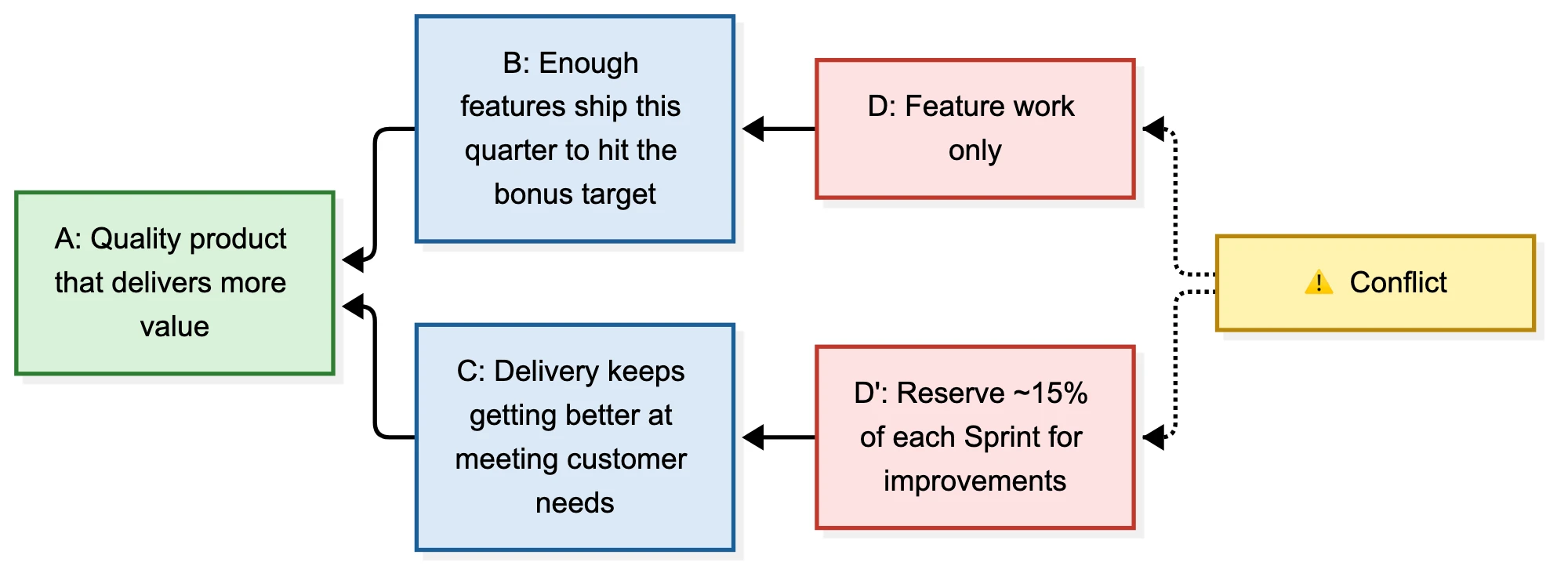
- Evaporating Cloud Diagrams - from Eli Goldratt’s Theory of Constraints. When two people or groups are on opposite sides of a conflict, the cloud puts conflict down on paper. The challenges become external to the people involved. Write a factual narrative of the problem, create the diagram, and identify the assumptions. By boiling it down to assumptions, the conflict can often be resolved.
For example, take the Sprint Planning “no time for improvements” surprise from the first example. The shared goal is a healthy product that delivers more value. To get there, enough features must ship this quarter to hit the bonus target, and what the team delivers must keep getting better at meeting customer needs. A senior team member, whose bonus counts features and nothing else, wants the Sprint spent on feature work only. The rest of the team wants about 15% of each Sprint reserved for improvements. The hidden assumption: “improvements can’t happen alongside delivery.” Once it’s on paper, the team can challenge the assumption and not each other.
Some Problems can’t be Resolved
Occasionally, people can’t find a way to work well together. When that happens, work with HR to document the problem and the steps taken to resolve it. Sometimes the best outcome is to find a different role for the person.
Any person no matter how senior, who sees their opinions as more important than the team, will eventually derail the team. But that’s rare; I’ve seen it only a couple of times in my career.
Focus on the Situation, Not the Person
The next time you see a difficult person, work through these in order:
- In the moment: ask questions instead of confronting. (Being mindful of this is my biggest weakness.)
- One-on-one: understand their context.
- Team: invite dissent and make use of working agreements.
- Beyond the team: look for differing priorities, incentives, and pressures pulling them away from the team.
- If all else fails: escalate to HR.
In most cases, you’ll find a good person stuck in a difficult situation. Change the situation, and magically the “difficult person” disappears.
Think back to the last time you had a “difficult person”, and ask yourself: which of these causes is driving their behaviour? What’s one question you could ask to find out?
Agile Pain Relief Blog Entries
Footnotes
-
Motivational Outlook Conversation - Susan Fowler, author of “Why Motivating People Doesn’t Work and What Does” 2nd Edition. ↩

Mark Levison
Mark Levison has been helping Scrum teams and organizations with Agile, Scrum and Kanban style approaches since 2001. From certified scrum master training to custom Agile courses, he has helped well over 8,000 individuals, earning him respect and top rated reviews as one of the pioneers within the industry, as well as a raft of certifications from the ScrumAlliance. Mark has been a speaker at various Agile Conferences for more than 20 years, and is a published Scrum author with eBooks as well as articles on InfoQ.com, ScrumAlliance.org and AgileAlliance.org.


