Where Does Your Work Sit and Wait?
Last Updated: November 2026
So much of what is written about Agile talks about software development. Books, case studies and almost all of my own writing. Even the vocabulary sounds technical: Sprints, Cycle Time, Velocity. The language holds us back.
Wherever I look, I see similar problems. Queues, waiting and too much work in progress. Lack of clear priorities. Problems that are worked around rather than solved. Working in silos. Changing conditions and markets, whether climate change, GenAI or tariffs. All of these things that Agile helps address.
I can’t demonstrate all of this in a single post. So let’s start with one system, one that makes our newspapers on a regular basis.
The Eighteen Month Clock
Canadians will remember that in 2016 the Supreme Court decided that if a criminal trial in provincial court doesn’t finish within 18 months of the charge being laid, the delay is presumed unreasonable and the charges are stayed, unless the Crown can show exceptional circumstances (R v Jordan1 and Section 11(b) of the Charter). In Superior Court it’s 30 months.
We see the results in the news: a case runs past 18 months and is thrown out. There is a call for more judges. The problem is that we don’t know if that is the remedy. At least as reported in the news and from the evidence I can find, there isn’t enough data to know what would solve it.
Draw the Work
“Visualize the work” is the first rule of Kanban. The goal is to make the work visible. Typically this is a board with a column for each stage of the process. The province of Ontario is the one that I could find the most data for, so we will use that for the example.
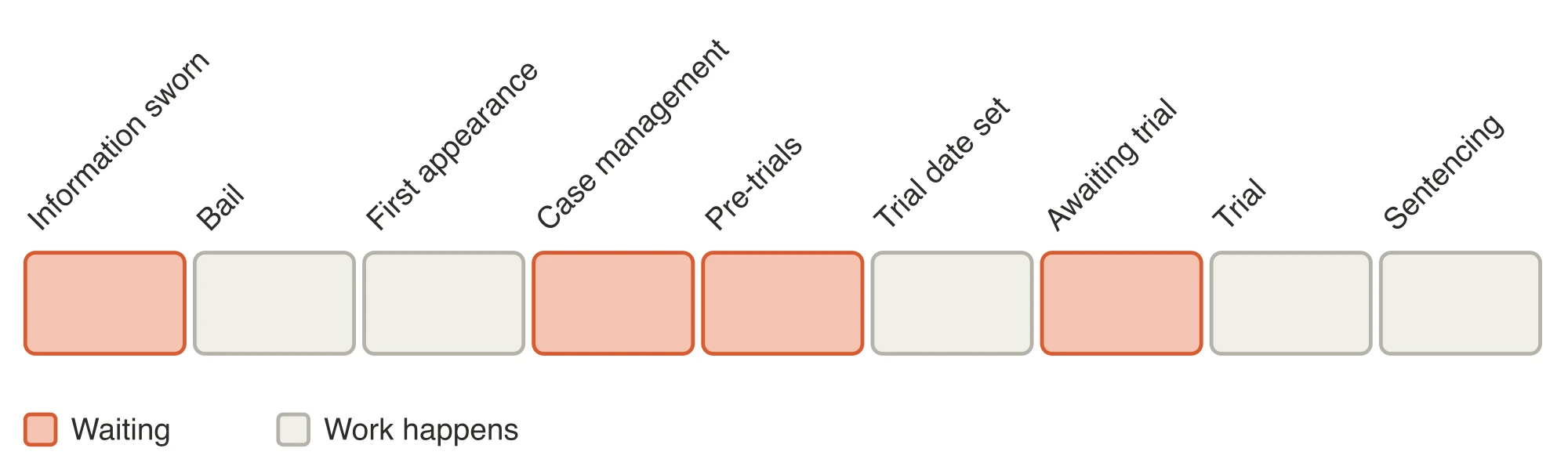
Information sworn, bail, first appearance, case management, pre-trials, trial date set, awaiting trial, trial, sentencing. Looking at those nine columns, the most interesting thing is that four of them are just waiting or mostly waiting. The clock starts ticking when the Information is sworn (i.e. the charge is laid) and only stops when the trial is over or the case ends in some other way.
- Information sworn - if the person charged is detained in custody, they will be brought before a justice within 24 hours. However, if they’ve been released or never detained, they can wait weeks. All of this time counts towards the 18 months.
- Case Management - A block of time for the Crown and the defence to exchange information about the case. It acts as a status check: has disclosure arrived, is it complete, are we ready to set a trial date yet? Ontario used to have administrative check-ins every few weeks. Now, if the accused isn’t in custody and has a lawyer, this is one twelve-week block to get it all done. If the accused is in custody or without a lawyer, they keep the more frequent check-in process.
- Pre-Trial - This involves two meetings. First the Crown and Defence meet on their own to see if there is a deal that can be reached, if diversion is possible and other options. Then they sit down with a judge who won’t be the trial judge. They narrow the issues and see if the case can resolve without a trial. Sometimes the judge will give a private, non-binding view of what a sentence would look like. This is the point where a lot of cases end with a guilty plea. The meetings themselves are short; the real time here is waiting to get one booked with a judge. If the case does go forward, then pre-trial covers trial logistics: what facts are agreed on, how many witnesses will be called, etc.
- Awaiting Trial - this is purely waiting.
The board already helps you see the flow of the system; however, without the data it’s hard to see where the bottlenecks are.
The Data
Amazingly, the data is already there. The Ontario Court of Justice publishes statistics going back to 2012. For the purposes of this story, I used: 2026-Offence-Based-Criminal.xlsx (April 2025 to March 2026) and 2026-Disposition-Rate-Criminal.xlsx (April 2024 to March 2026).
April 2025 to March 2026: the court completed 247,586 criminal cases and still had 148,473 pending. Excluding cases where the accused failed to appear, the average case took 185 days and 9.5 court appearances. Only 3.7% ended in a trial.
The data itself tells us that the system has a capacity of 247,586 cases a year through a known number of courtrooms and judges. The Court has set itself a 15 month target, three months under the legal ceiling. Around 5% of cases still run past 18 months and that number appears to be going up.
The problem is that the data is abstract. By putting it on a board, you can see the flow of the system.
- Where do the cases get stuck? The data doesn’t tell us which of the columns had the adjournments. However, the court has a practice direction that sets out to cut “unnecessary administrative appearances” in case management court. So the direction suggests that’s where they accumulate.
- Show the Waiting A board shows us how many cases are waiting for first appearance, disclosure, pre-trial meeting and awaiting the trial itself.
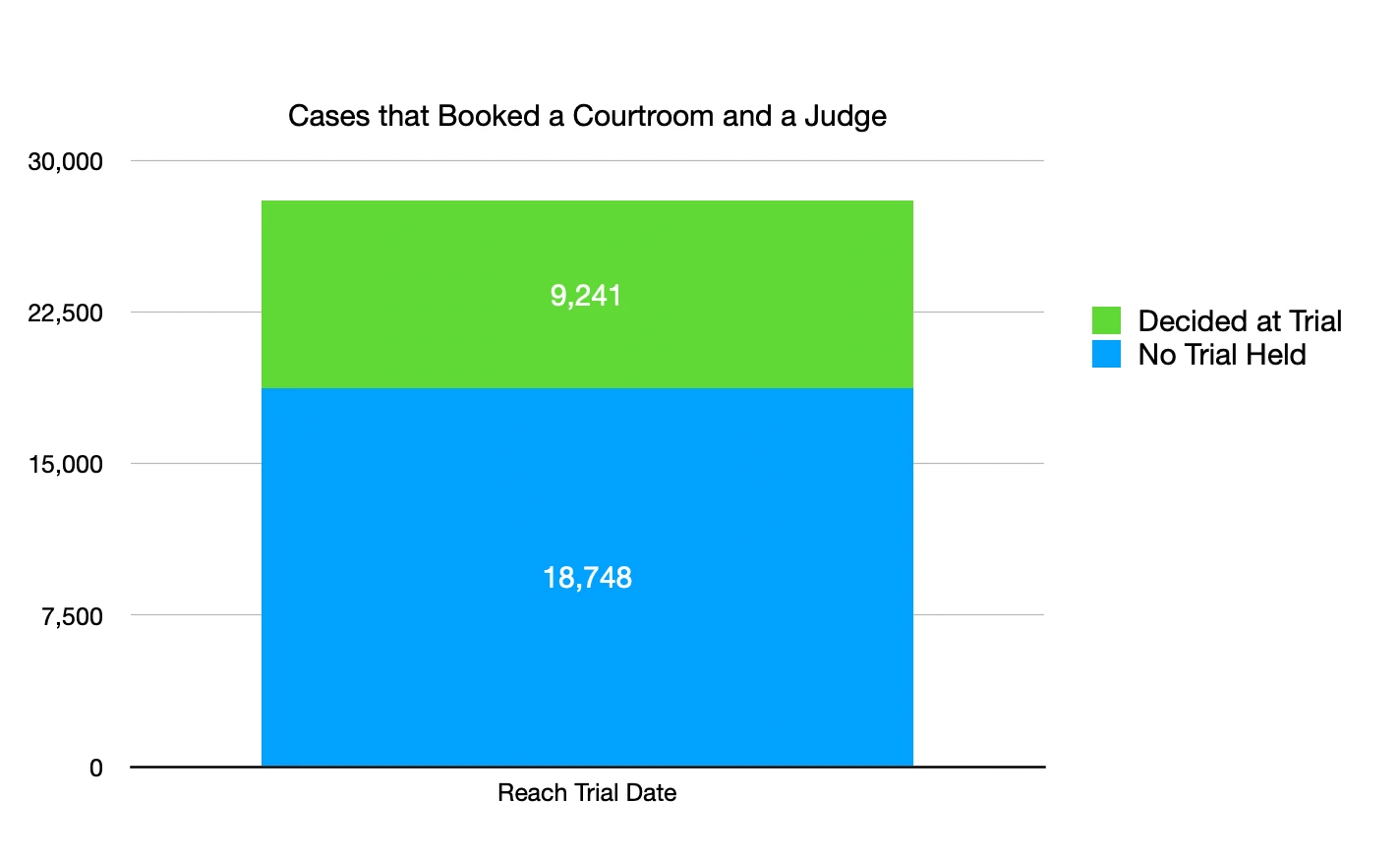
- Show the Waste Of the 27,989 cases that reached a trial date, 18,748 ended without a trial. 7,996 were last minute guilty pleas. 10,622 were withdrawn on the day. The other 130 ended some other way. The data doesn’t tell us why. More cases are withdrawn on the day of the trial than go to trial.
I’m Not a Lawyer
I’m not a lawyer. Claude is definitely not a lawyer, even if it uses legal-sounding language. I’ve never been inside a working court room, so I don’t know what the real issues are.
What I can see from the data is that the system has evolved since 2012. Some of the changes have clearly helped. Honestly, this is better than I expected, reading news articles. The data doesn’t have enough detail to tell us what the real issues are.
With a real Kanban board, I would want to look at:
- Outliers - the cases that take the longest in any one column often tell us the most about what is happening in the system.
- Last minute change - with two-thirds of the cases at the final stage of the process ending without a trial, I would want to know why. Can this be reduced?
- If we improved the policies between one stage and the next, would that help?
Lastly, where are the bottlenecks? Lack of court rooms? Judges? Crown prosecutors? Defence attorneys?
As it stands, the publicly available data doesn’t tell us.
Agile Isn’t About Software
Even without all of the fancy language of Cycle Time, Work in Progress, etc. we’ve found a way to model the court system and tell a story about where to look for the opportunities for improvement.
I described the court system; however, the same approach could be used for a hospital, a planning department, a law firm. Anywhere that has a process and a queue of work.
Where else do you see queues of work that aren’t being measured? Where else could we apply an Agile approach to improve?
Footnotes

Mark Levison
Mark Levison has been helping Scrum teams and organizations with Agile, Scrum and Kanban style approaches since 2001. From certified scrum master training to custom Agile courses, he has helped well over 8,000 individuals, earning him respect and top rated reviews as one of the pioneers within the industry, as well as a raft of certifications from the ScrumAlliance. Mark has been a speaker at various Agile Conferences for more than 20 years, and is a published Scrum author with eBooks as well as articles on InfoQ.com, ScrumAlliance.org and AgileAlliance.org.


