Using GenAI as a Thinking Partner and not a Replacement for Your Thinking
Last Updated: October 2026
GenAI hands you an answer; the risk is that you stop doing the thinking yourself. The more we trust it, the less critical thinking we do.1 In fancy pants systems thinking language, this is a reinforcing feedback loop. In plain English, a vicious cycle. I looked at what that costs over time in Skill Loss and GenAI.
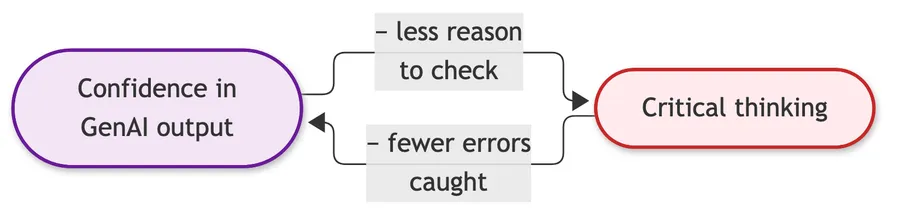
The rigour behind systems thinking and critical thinking isn’t natural. I’ve been using them with teams for years, and I still don’t remember to check every angle each time I think through a problem. So I built four agent skills (packaged instructions that tell Claude, Codex, and other GenAI tools how to run a structured thinking session) that do the remembering for me.
These skills are designed to put you in the driver’s seat, with the LLM as a thinking partner. The skills get the model to ask you questions and use your answers to decide which questions to ask next. Instead of replacing your thinking, they help you see things from a different perspective (systems thinking) or test it (critical thinking). You don’t need to remember a command. Ask your GenAI tool the kind of question you’d ask a colleague, like “Why does this keep happening?” or “Is this a good decision?”, and it usually picks the right skill. To run a specific skill, type its name as a command, like /critical-thinking. You’ll see that in the examples below.
The Skills
| Skill | What it’s for |
|---|---|
| Systems Thinking | Problems that keep coming back. Traces causes upstream, finds the feedback loops holding a situation in place, and draws Causal Loop Diagrams when the picture would help. |
| Critical Thinking | Claims, conclusions and decisions that need testing before you act. Paul and Elder’s eight Elements of Reasoning and nine Intellectual Standards, asked as questions - starting from wherever your thinking already is. |
| Critical Thinking for GenAI | Text a model produced, where asking the model to explain itself doesn’t work because it has no reasoning to retrace. Eleven probes that test the output itself. |
| Evaporating Cloud | Two reasonable choices that conflict. Draws Goldratt’s Evaporating Cloud to surface the assumptions behind each side. Probes for an action that meets both needs instead of splitting the difference. |
Systems Thinking
Systems thinking explores problems that behave like whack-a-mole: fix one and another pops up. It also helps answer a different question: if we make this change, what else will be affected? The loop at the top of this post is the kind of picture the skill draws. Problems like these are a good place to start:
- Every Sprint ends with unfinished work carried over
- Production fixes keep finding other problems in the product
- Our best people keep leaving, and the people who remain are stressed and exhausted
- Every reorganization promises faster decisions, and two years later we reorganize again
Critical Thinking: Human and GenAI
Critical thinking comes as two skills: one for your own thinking and one for GenAI output. The human skill follows Richard Paul and Linda Elder’s well-researched Elements of Reasoning2: Purpose, Question, Information, and so on. You tell the model how far you’ve got in your thinking and the skill asks questions to find the gaps and test the assumptions.
When we work with GenAI and it makes a mistake, or a claim we’re not sure about, we can’t just ask the model to explain its reasoning. The model isn’t self-aware and doesn’t have an explanation. (GenAI vs Human Intelligence explains why.) Instead, in response to a question: “Why did you make that mistake?” or “How did you come up with that answer?”, it generates a plausible response based on the text already in the conversation.
Run the critical-thinking-genai skill in a new conversation. If you continue in the same conversation, the text already there influences everything the model generates next. A model can’t unsee text it has already generated. Use a different model if you can. Some tools, like Claude, save fragments of past conversations to memory, and that memory can carry into the new conversation. A different model also brings different training and different biases, so it may pull in information the first model missed and help you reach a new conclusion. You paste in the claim or answer that surprised you, and the skill helps you identify what needs to be clarified or tested. Based on what you learn, it might suggest rephrasing the original prompt and starting over, or looking for external evidence that supports or refutes an assumption.
Example: Should I buy this course?
I was considering an online course to help me improve my communication skills. I ran the critical thinking skill: /critical-thinking
This was a much longer conversation. I’m eliding my personal details and the details of the course.
Purpose: To improve the way I communicate with people, both in workshops and my personal life.
Question: Can a six-week online course help me make meaningful progress? Will I get US$250 worth of value?
Information: I’ve read some of a book on communication. The core ideas are good; the challenge is remembering to put them into practice.
Key questions the model asked me:
- Where do you stand in this decision?
- Has a structured program with live check-ins ever actually changed whether you practiced?
- Does this course replicate what made [the earlier program] stick?
- Does this course deliver practice and feedback, not just more concepts?
The questions helped me see that the course wouldn’t help. It would have joined the many courses I’ve bought that sit on the shelf.
Example: Wider bike tires
I was buying a new bike this summer and I hadn’t looked at bike technology in nearly 20 years. I asked Gemini to tell me what technologies had changed in that time. I was expecting to get back details about frame materials, the rise of disc brakes and maybe drivetrains. I got all of that, but it also told me tires are now wider and run at lower pressure. That didn’t make sense to me. I’ve spent nearly 50 years riding on narrow 1” tires at 80-100 psi. The model was suggesting 1 2/3” at 40 psi. I couldn’t believe it.
My surprise was the signal to check. The critical-thinking-genai skill didn’t exist yet, so I couldn’t run it. Instead, I went looking for independent sources on tire width and pressure, and they confirmed the model was basically right.
The out-of-date assumption was mine. Critical thinking cuts both ways: it tests the model’s claims and what you’re sure you already know. I’m now riding wider tires at lower pressure.
Critical Thinking and Agile Problems
You may not be weighing a course. The same approach works on the claims and improvement ideas you hear at work, like:
- Scrum has too many meetings, so let’s switch to Kanban (suggested by a team member)
- Adding another step in the review process will reduce the number of defects (an improvement suggested at the Retrospective)
- Everyone agreed on the new supplier in ten minutes, so it must be the right choice
- GenAI will make our developers twice as fast, so we can shrink the team
- Add two more developers and we’ll make the Q2 date
- Velocity dropped, so the team isn’t working hard enough
Run the skill whenever a decision has a long-term cost or consequence, even when that consequence isn’t obvious. Take the supplier example: everyone agreed, so it looks like a good decision. But without enough reflection, agreement on the surface can hide deeper issues.
Evaporating Cloud
Evaporating Cloud Diagrams (also called Conflict Resolution Diagrams) are a tool from Eli Goldratt for resolving conflict without creating a compromise.3
When two groups or people are on opposite sides of a conflict, the diagram makes the disagreement visible, so the debate is about ideas, not people. Instead of arguing over a big idea, you boil the issue down to conflicting assumptions. Even if we don’t get an immediate resolution, the process lays bare the key differences between the two sides, so we can design an experiment to test the assumptions.
It works just as well when the conflict is inside one person: two choices you want to make that pull in opposite directions. The car example below is one of those.
The skill reduces the conflict to needs and assumptions. Along the way, it challenges your thinking: Can you prove that an assumption you hold is valid?
Example: Cash or finance a car?
I’m not in the market for a car (I already bought a bike this year), so this one is hypothetical. Say I want a $50,000 car. Paying cash avoids interest but wipes out my emergency cushion; financing keeps the cushion but costs interest. I ran /evaporating-cloud.
I started with the goal “get a new car”. The skill pushed for something clearer, then walked me through my assumptions.
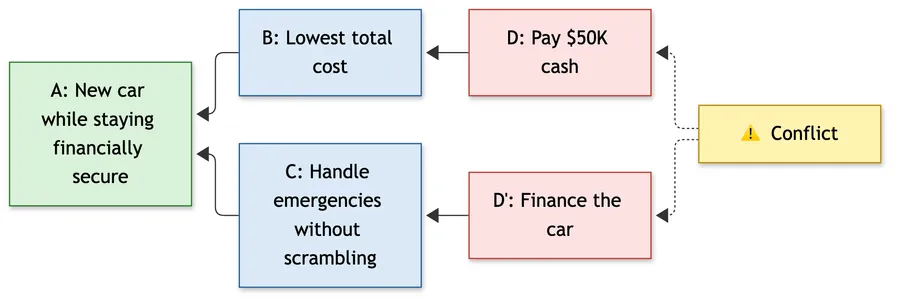
Key assumptions (my answers, lightly trimmed):
Lowest cost requires paying cash, because…
- Financing always costs interest, so cash is cheaper
- The $50K cash would be collecting interest in a GIC (Guaranteed Investment Certificate), at a lower rate than the car’s interest payments.
- Dealers want to finance the car, so paying cash doesn’t get a discount.
Emergency readiness requires financing, because…
- I wouldn’t have six months of cash on hand if I had an emergency.
- No other sources of cash.
I can’t do both, because…
- If I pay cash then there is nothing to finance.
- The lowest interest rate needs the full amount financed for 3 years, so I can’t pay part in cash.
The assumption that broke was “financing always costs interest”: with 0% dealer financing, I can finance the car and leave the cash in the GIC, which gives me the lowest total cost and keeps my emergency cushion.
Evaporating Clouds and Agile Problems
Conflicts like these show up in most organizations:
- Every planning session ends in the same fight over features versus technical debt
- Two teams each need the same specialist full-time
- Let the team self-organize, or step in to hit the deadline (a conflict inside one leader’s head)
- Keep teams stable, or move people to the urgent project
- Sales wants to discount aggressively to hit quarter end; Finance wants to hold prices firm to protect margins
Breaking the Cycle
Remember the reinforcing feedback loop from the start of this post: the more you trust the output, the less you check it. The skills are designed to break that loop, so the model supports your thinking instead of replacing it.
These skills never have the model refer to itself as a person. It asks you to “provide an example”, not to “give me an example”. It doesn’t say “I think” or “let me draw that”.
Using personal pronouns with GenAI models leads to errors where we falsely attribute human thinking to the model. A model that speaks as “I” invites you to treat it as a colleague who has weighed the evidence and formed a view. It hasn’t weighed the evidence, and any views it shares are just the most statistically likely text, based on its training data. The moment you forget that, you stop checking its work, which is the one thing these skills exist to keep you doing.
GenAI is a prediction tool. It can’t do your thinking for you. Bring the rigour of critical thinking and systems thinking to the problems you face, and let the model help you do it.
Get the Skills
The skills are here: agent-thinking-skills. The project provides all the installation instructions. Download them and try Systems Thinking or Critical Thinking on a problem you’re wrestling with this week.
If you have a GitHub account, please star the repository. Apparently that’s how reputation works there.
Image attribution: © Agile Pain Relief Consulting (October 2026). Drawn with Linea Sketch.
Footnotes
-
Hao-Ping (Hank) Lee, Advait Sarkar, Lev Tankelevitch, Ian Drosos, Sean Rintel, Richard Banks and Nicholas Wilson (25 April 2025). The Impact of Generative AI on Critical Thinking: Self-Reported Reductions in Cognitive Effort and Confidence Effects From a Survey of Knowledge Workers. Proceedings of the 2025 CHI Conference on Human Factors in Computing Systems. ↩
-
The Elements of Reasoning and the Universal Intellectual Standards are the work of Richard Paul and Linda Elder at the Foundation for Critical Thinking. ↩
-
The Evaporating Cloud is one of Eli Goldratt’s Theory of Constraints Thinking Processes. He made it widely known in his 1994 business novel It’s Not Luck. ↩

Mark Levison
Mark Levison has been helping Scrum teams and organizations with Agile, Scrum and Kanban style approaches since 2001. From certified scrum master training to custom Agile courses, he has helped well over 8,000 individuals, earning him respect and top rated reviews as one of the pioneers within the industry, as well as a raft of certifications from the ScrumAlliance. Mark has been a speaker at various Agile Conferences for more than 20 years, and is a published Scrum author with eBooks as well as articles on InfoQ.com, ScrumAlliance.org and AgileAlliance.org.


