Have You Seen a Strategic Plan That Worked?
Last Updated: November 2026
I continue to be amazed by how much the internet gets wrong. According to its average wisdom, “70% of strategic plans fail”. If it were true, it would be a handy statistic, and I could finish this post with only a few paragraphs. The problem is that I can’t find a reliable source for it. Strategic plans do fail. They fail because they were not actual plans in the first place. Consulting thousands of people and spending a year or more to create a PDF that summarizes the results is not a plan.
We have a lot more visibility into what happens in the public sector. Publicly funded institutions have greater reporting obligations, so it is easier to see their plans and assess the results. Similar strategic missteps happen in the private sector, but it is harder to get the details.
Ontario College Immigration Shock
For more than a decade, Ontario colleges were encouraged to bring in a large number of international students, because they paid higher tuition fees. The province had already capped domestic tuition and left the colleges to make up the difference. International students became the colleges’ biggest revenue source, and their biggest risk.
In June 2023, the Algonquin College Board of Governors received a six-year academic plan.1 It was the result of 18 months of study, drawing on “over 2,100 voices”. It promised to be a roadmap for the next 6 years. The goal was to adapt to the “Changing Educational Landscape”. Less than eight months later the federal government reduced the number of international student permits by 35%. Since then Algonquin has cut nearly 70 programs. Even after all of these cuts, the college website still shows the 2023 plan as the current academic plan. No review, no updates and no published progress.
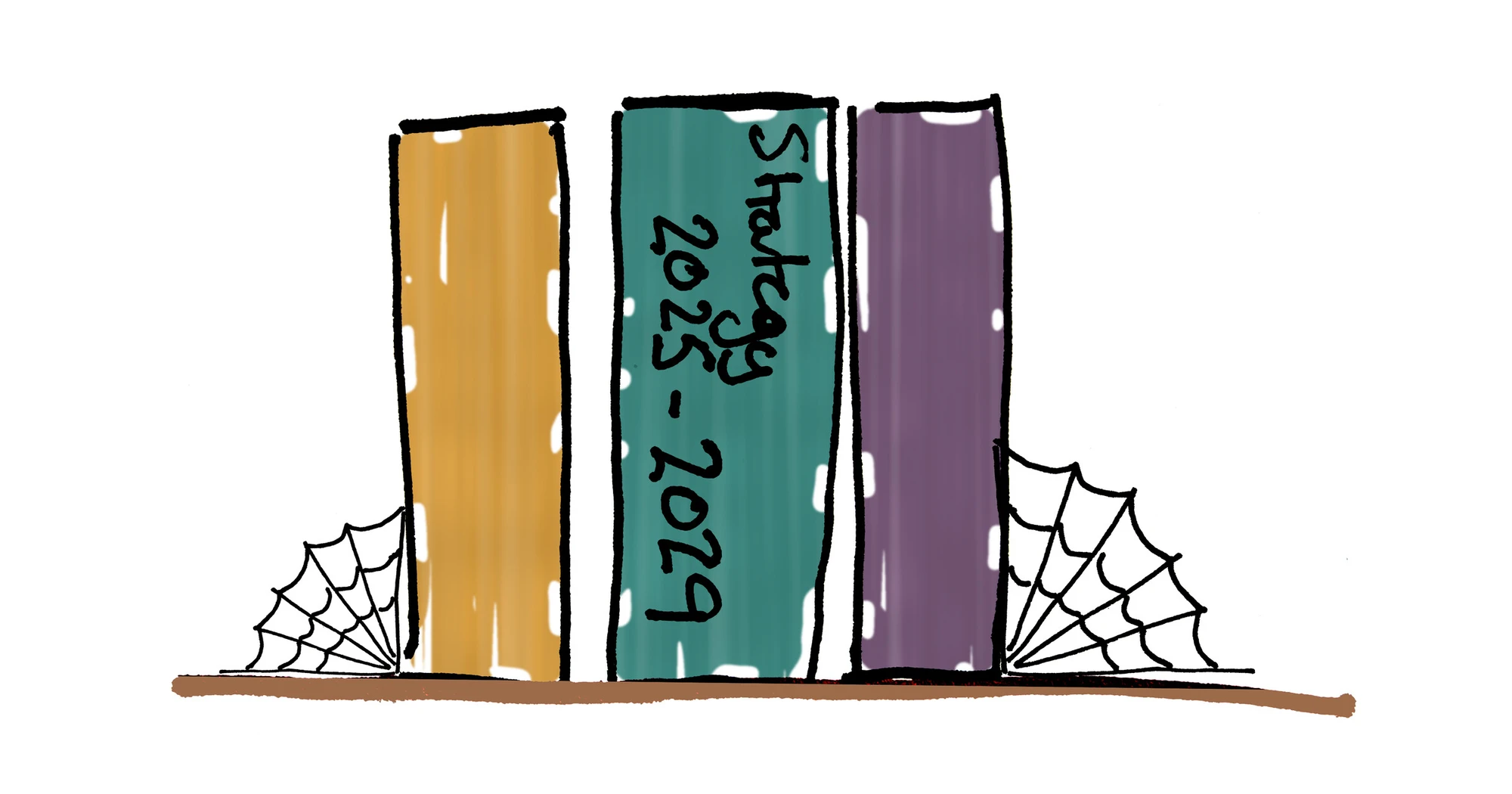
It’s not all bad. Algonquin’s plan had clear boundaries, and its diagnosis covered many of the real challenges (AI, automation, a shifting labour market, etc.). It was also developed from the bottom up, not the top down.
Northern College published a plan in January 2021, Exceeding Expectations: A Strategic Plan for Northern College 2020–2025.2 The plan promised a review in April 2021 with follow-up reviews quarterly thereafter. No review was ever published. At least they appear to have sunk only six months of work into the plan. Like Algonquin, Northern had staff and program cuts in 2025 and 2026. The Northern plan had 13 Institutional Commitments, 3 Strategic Directions, and 11 Strategic Objectives. This is more like a wish list than a plan. Further, there are no concrete actions to be taken.
This isn’t a failure of the people involved. It was a good-faith effort by people trying to do the right thing, overtaken by events.
Cambrian College’s plan3 gets some things right: “To do that, we need a living plan – one that allows us to show evidence of progress to our Board and other stakeholders, and allows us the flexibility to pivot as conditions change.” It even had a headline: “WE WERE PREPARED TO BE WRONG”. In addition Cambrian publishes an annual progress report on the plan.4 Cambrian built in the flexibility to pivot and published its progress.
Most Strategic Plans Are Neither Strategic nor Actionable
I’ve seen this in my own consulting work, as well as the examples above.
I worked with one private sector client for over a year. I never saw the plan. I was told that it existed. What I did see was a steady stream of demands from individual stakeholders, forcing the product team to change direction again and again. Work sat in a queue for months, waiting for the steering committee to approve it. Much of the work waited so long that by the time it was approved, it was no longer relevant. Without a clear plan, there is nothing to guide the decision making process.
In the plans I reviewed, many were a series of hopes and aspirations; only a few included targets. In addition, these plans took anywhere from 6–18 months to create and involved hundreds to thousands of people. When we take 18 months and thousands of people to create a plan, there is an implicit promise that we will deliver great change. The reality is that these plans are almost never delivered.
A strategic plan is really a hypothesis about making a change and getting to a better state. As with any hypothesis, it has untested assumptions. Agile approaches excel at testing assumptions and forcing us to adapt when they’re wrong. Prior to 2024, the colleges assumed they had a long timeline to adapt to a changing market. Reality had other plans.
Most of the plans I reviewed weren’t adaptable, so when Immigration Canada reduced the number of international student permits, the plans were useless.
Finally, Cambrian was the only college whose plan was updated regularly, with published progress. Did it work? It’s hard to tell from the outside. Cambrian suspended 16 programs, but avoided layoffs (mostly through attrition). Their international student numbers dropped by almost half and their domestic student numbers grew far less than they lost. There are enough confounding factors that we can’t say that the plan was what made the difference.
A plan without clear actions, targets and regular updates is not a plan. It is a hope.
An Agile Approach to Strategic Plans
Long-range plans don’t survive contact with reality. Wildfires, pandemics, immigration policy changes and tariffs are all things that happen at a moment’s notice. Any one of these will take out a plan that took months or a year to create.
The usual Agile answer would be to create a small plan and iterate on that plan. But two problems bedevil many organizations:
- Lack of early engagement with key stakeholders makes it harder to get buy-in as the plan is rolled out.
- Viewed in isolation, many improvements made at one level of the organization don’t make an overall difference.
How do we balance the need for action with the need for buy-in and meaningful change? Richard Rumelt’s “Good Strategy Bad Strategy”5 provides a framework. The kernel of a good strategy is:
- A diagnosis that explains the challenge
- A guiding policy that explains how the challenge will be overcome
- A set of coherent actions to carry out the policy
There is a lot we don’t know about what was going on with the strategic planning process at Ontario colleges, so I will use a fictionalized example.
Kernel of a good strategy – First 30 days
Leadership must do the diagnosis work to understand the real issues. (Hint: Systems Thinking. Be careful, many initial diagnoses are the symptoms, not the myriad causes.) Define a clear statement of how the challenge will be overcome. The guiding policy must explain what is in scope and what is not. Create the first set of coherent coordinated actions. These must cut across departments and silos. Many strategic plans fail because they’re implemented in silos.
Diagnosis: The 2024 drop in international students, frozen domestic tuition and changes in the needs of regional employers are all factors in the financial crisis for the institution.
Guiding Policy: We will shift our focus from long programs and international students to domestic reskilling and micro-credentials.
Coordinated Coherent Actions:
- Turn the first year of selected programs into 4-week micro-credentials. These can be taken either by adult learners (online) or by full-time students (in person).
- Deploy a standard Learning Management System, so that course materials can be shared between online learning and in-person.
In reality there would be several more actions; in this example I’m keeping it short.
Initial Consultation – Next 60 days
Pick one or two areas of change to focus on, consult with the stakeholders in those areas. The goal is both to understand their needs and concerns and to get them to engage in reviewing the changes as they roll out.
In the process of consulting, define the first set of achievable objectives. Rumelt aims for one to three objectives over the next 12–18 months. The objectives have to be clear and feasible. It should be possible to measure progress towards the objectives.
Example Objectives:
- In the next 12 months, in partnership with local employers, we launch five stand-alone micro-credentials, enrolling at least 200 adult learners by the end of the year.
- At the end of 12 months, all staff in the involved departments are using the new Learning Management System, to deliver at least one of their courses.
Execution – 30-day Sprints
Make a plan for what can be achieved in the month. Focus on delivering the value itself and not just PowerPoint presentations. At the end of the month, review what has been completed and adjust the plan going forward.
Many of the plans I reviewed involved working on many projects at the same time. As the evidence on Work in Progress shows, the more items in progress, the less that gets done. So have only one or two major projects in progress at a time. Only when we consider one project complete should we start the next. As an added bonus, if something like the immigration policy changes, only one or two projects are immediately affected, so we can pivot with a lower cost.
During the month, look for anything that is getting in the way of achieving the plan: often cross departmental dependencies or lack of alignment towards a common goal. For this reason, the execution must involve people from groups that are involved in the change. Where issues arise that can’t be resolved at the team level, senior leadership should be available to help.
Involve the stakeholders early and often as work progresses. Part of maintaining their buy-in is to show progress towards the objectives. At the very minimum, show them what has been achieved at the end of the month.
Example Focus: Sprints 1 and 2
- Configure the LMS and create the first micro-credential in the system
- Test the system with a few faculty members and the first group of students
Quarterly Review and Pivot
Every quarter, review and update the plan so that it always reflects reality. In the process, work with the current group of stakeholders to review the progress on the plan and to see if their needs have been met. If they have then we can move on to the next group. In this way, we can still meet the needs of a large number of people, but without the massive overhead of an 18 month plan.
Q1 End of Quarter Review
- Check: 40% of the faculty in the involved departments have started to use the new Learning Management System, to create their first micro-credential.
- Adapt: Some instructors are having trouble adapting existing course material to the micro-credential format. Two people with instructional design experience are made available to help them individually.
This isn’t just about colleges. Many plans fall into the same traps: annual roadmaps, OKRs, Agile transformation plans. Too many goals, no coherent set of actions and never updated again. Ask out loud: Does our strategic plan rule things in and out of scope? Does it have a clear set of actions? Is it updated regularly? Our consulting work starts with these questions.
Plans are useless, but planning is essential
I’ve seen this quote attributed to Eisenhower, Churchill and others. Without a plan, changes get made almost at random. However, a strategic plan that takes over six months to create, doesn’t contain a coherent set of actions to be taken and doesn’t get updated is wasted effort.
For plans to be useful, they need to chart a clear path forward and be updated regularly.
Which type of strategic plan does your organization have? A PowerPoint deck that was written once and is now archived in SharePoint? Or a document that is used to make decisions and gets updated?
Image attribution: © Agile Pain Relief Consulting (November 2026)
Footnotes
-
Algonquin College, Academic Plan 2023–2029 (PDF) ↩
-
Northern College, Exceeding Expectations: A Strategic Plan for Northern College 2020–2025 (PDF) ↩
-
Cambrian College, Strategic Plan 2020–2025 (PDF) ↩
-
Cambrian College, Strategic Plan 2025–2030 ↩
-
Richard Rumelt, Good Strategy Bad Strategy: The Difference and Why It Matters ↩

Mark Levison
Mark Levison has been helping Scrum teams and organizations with Agile, Scrum and Kanban style approaches since 2001. From certified scrum master training to custom Agile courses, he has helped well over 8,000 individuals, earning him respect and top rated reviews as one of the pioneers within the industry, as well as a raft of certifications from the ScrumAlliance. Mark has been a speaker at various Agile Conferences for more than 20 years, and is a published Scrum author with eBooks as well as articles on InfoQ.com, ScrumAlliance.org and AgileAlliance.org.


